
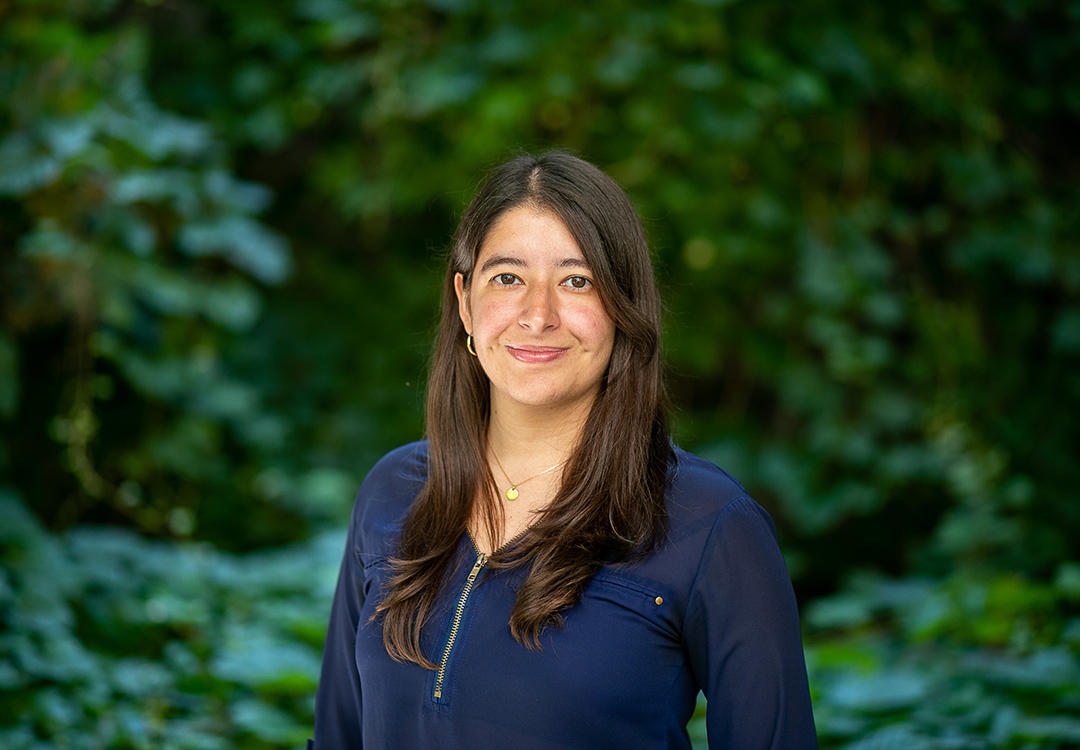
New veterinary lecturer has much to celebrate at USask Fall Convocation
When Dr. Lorena Santos (DVM) moved to Saskatoon in 2023, nearly 4,000 kilometres separated her from the city she had called home.
By Cat ZensRaised in Mexico City, one of the largest cities in the world, Santos traded busy streets and a familiar culture for the open skies of the Prairies and a combined residency-master’s program at the Western College of Veterinary Medicine (WCVM).
“It was definitely a huge change, but I love it here,” said Santos. It’s a very colourful, happy place, and the fact that there’s also Latin people here makes it feel like a little piece of home.”
Three years after arriving in the city, Santos looks forward to receiving her Master of Science (MSc) degree at the University of Saskatchewan (USask) 2026 Fall Convocation on Nov. 10. She’s also settling into her new role as a large animal medicine clinician and lecturer at the college.
“[Convocating] is huge from a professional perspective — doors have opened for me, like being able to apply for this position as a lecturer,” Santos said.
After earning her Doctor of Veterinary Medicine degree and a master's degree in equine medicine and surgery at the National Autonomous University of Mexico (UNAM), Santos spent several years working in private practice as well as preparing for her goal of studying internationally.
“Being able to study abroad was something I always worked for,” she said.
This ambition would lead Santos north to Canada where she completed an equine internship at the University of Guelph’s Ontario Veterinary College (OVC) before matching into a residency in large animal internal medicine at the WCVM.
For Santos, the program combines three interests that emerged during her training at the veterinary college: teaching, clinical practice and working with horses.
“The residency program here offers you opportunities to teach — giving lectures to third or fourth-year students for example — and interact with them during rotations at the clinic,” she explained. “[The experience] confirmed that this was something I really wanted to pursue.”
Alongside her residency, Santos completed a master's degree under the supervision of Dr. Fabienne Uehlinger (DVM, PhD), a WCVM associate professor and a specialist in large animal internal medicine at the college's Veterinary Medical Centre (VMC).
“Dr. Uehlinger basically introduced me to research, and she’s my guru in that regard,” said Santos, adding that Uehlinger’s mentorship was invaluable during her internal medicine residency.
“She takes the time to explain and discuss cases in great depth, which is how we learn. I really feel that ‘I squeezed all of the juice’ out of those discussions.”
Santos’s MSc research project focused on antimicrobial use in horses, drawing on medical records from the VMC. She analyzed nearly 1,600 equine patient records collected between 2019 and 2023. The project examined how antibiotic drugs were prescribed and documented, creating a baseline understanding of prescribing practices in western Canadian equine medicine. The work required years of reviewing records, tracking prescriptions and identifying patterns in antimicrobial use.
“From a One Health perspective, these studies are really important because it’s the only way we have to monitor how well or not [well] we are doing with our prescribing practices, and if we can mitigate antimicrobial resistance,” Santos said.
Working with horses back in Mexico, Santos was especially interested in examining how antimicrobial resistance affects the species.
“Given the fact that they are considered companion animals, I thought that it would be very interesting to investigate antimicrobial resistance in horses because we are in such close contact with that species,” she said.
Due to the widespread impact of antimicrobial resistance, she hopes her data can also be used to analyze antimicrobial use in other species — including people. Among her findings, Santos observed encouraging trends. Veterinarians appeared to be using certain antibiotic drugs more selectively to help guide treatment decisions. At the same time, the study revealed opportunities to improve how medical information is documented and organized in patient records.
“The problem is that how the information is recorded was not consistent,” said Santos. “I was not able to find every single prescription from these patients, [affecting] my data.” She noted that these discoveries serve as a future opportunity to improve how client records are stored.
In June 2025, Santos travelled to Kentucky to present her findings at the American College of Veterinary Internal Medicine’s (ACVIM) annual conference. She’s aiming for her work to be published in a peer-reviewed journal in 2027.
Her project is helping to support additional research at the WCVM: Dr. Mónica Arévalo Naranjo (DVM), a resident in large animal medicine, is investigating if horses treated with ceftiofur, a commonly used antibiotic, show evidence of resistance to the drug. Her work is supervised by Uehlinger and Dr. Joe Rubin (DVM, PhD), a WCVM veterinary microbiologist.
Santos is teaching courses in equine medicine and surgery as well as food animal production medicine in the college’s Doctor of Veterinary Medicine (DVM) program. As Santos settles into her new faculty role, she remains focused on what drew her to a career in academia in the first place.
“I’d say my biggest motivation is definitely being a professor and a lecturer,” she said. “I think I’m very oriented to teaching.”
Looking back on the path that took her from Mexico City to Saskatoon, Santos sees her new role at the WCVM as both a personal and professional achievement.
“I’m very excited about it, it’s another huge step in my career. Achieving this is huge for me.”