
Student award honours Blakley’s love for teaching and toxicology
Even after his passing in 2024, Dr. Barry Blakley (DVM, PhD) continues to celebrate students who excel in veterinary toxicology — the specialty he loved.
By Jessica Colby“He knew how important it was to support students and certainly to recognize students who were excelling in an area that he loved,” says Dr. Pat Blakley (MD, PhD), Barry’s widow. “He was a storyteller and a detective. Toxicology lends itself to that.”
Barry was a faculty member at the Western College of Veterinary Medicine (WCVM) for nearly 44 years. He was also a University of Saskatchewan (USask) alumnus: he earned a Bachelor of Science (chemistry) degree in the College of Arts and Science, followed by a Doctor of Veterinary Medicine (DVM) degree and a Master of Science degree in veterinary physiological sciences at the WCVM. Barry went on to complete his PhD in toxicology at the University of Cincinnati in 1980.
“His heart had always been in a practice that incorporated both clinical and academic work,” says Pat, who met Barry while they were both graduate students in Ohio. “He really loved teaching the students, and that was something that was very important for him."
Throughout his career, Barry was consulted on many toxicology cases and disease investigations from veterinarians and livestock producers alike.
“I was not aware of how far his influence spread until he passed, and we received condolences from across Canada and the U.S.,” says Pat.
Barry, who originally planned to retire in June 2024, had started initial work on two scholarships before his cancer diagnosis in early 2024. Both awards were established in his memory after his death in March 2024. Pat presented the Dr. Barry Blakley Graduate Student Award to its first recipient, PhD student Dr. Chinelo Uju, in fall 2025.
The second scholarship, the Dr. Barry Blakley Award for Veterinary Excellence in Toxicology, recognizes one second-year WCVM student who has excelled in veterinary toxicology. Based on a gift from Barry’s family, the annual award provides $1,500 to the recipient.
“[The award is] a combination of [his] love of teaching and imparting his vast knowledge of veterinary toxicology,” says Pat.
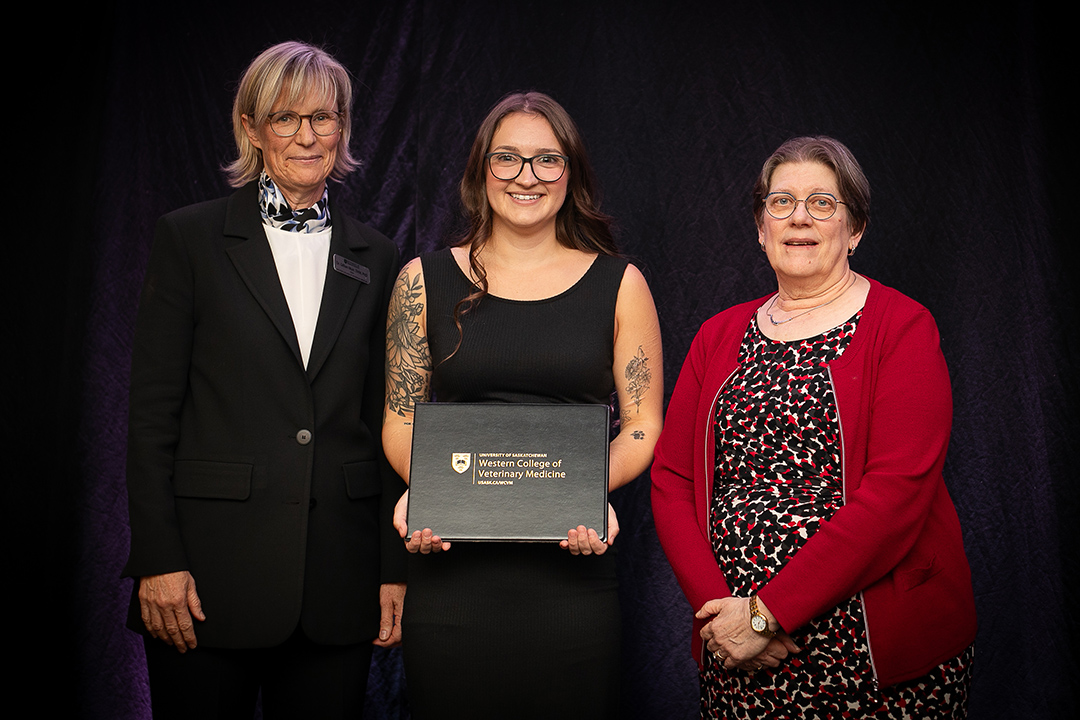
The award’s inaugural recipient is Saylor Martian, a third-year veterinary student originally from Vernon, B.C. Before beginning her veterinary studies, Martian obtained a Bachelor of Science in Animal Health degree at the University of Alberta in Edmonton, Alta.
Growing up, Martian loved both animals and school. Veterinary medicine offers the best of both worlds for her, combining her interests in animals and learning.
“I worked in vet clinics during high school back home and all of my mentors there, this [WCVM] is where they went to school, so I wanted to follow in their footsteps,” says Martian, who found extra joy in her education during her second-year veterinary toxicology course.
“I think it’s so fundamentally important as a vet to know what things in everyday life and everyday environments can be harmful to our pets,” she says.
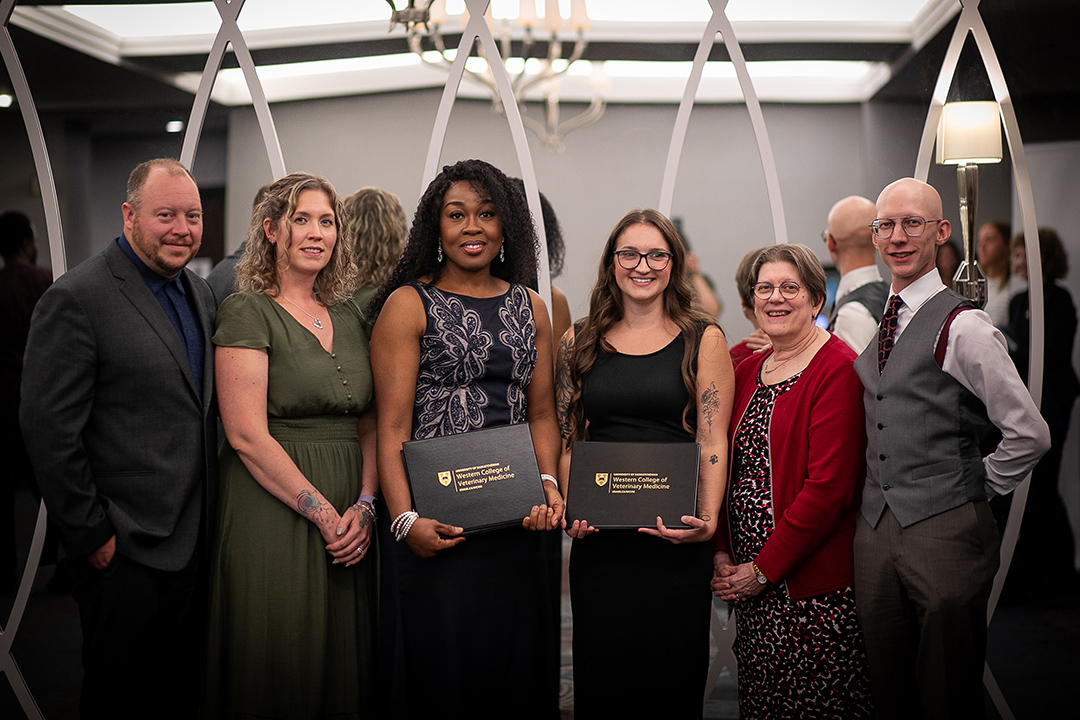
Martian notes she studied very hard in the toxicology course and enjoyed learning about the topic, but the award “wasn’t even on [her] radar as something [she] was thinking [she] won,” and she was “quite shocked” when she found out about the honour.
“It feels really good to be recognized for that hard work and that achievement,” says Martian, who accepted the award from Pat during the WCVM’s annual fall awards program in October 2025. “I put a lot of effort into that class because I enjoyed it so much.”
Now in her third year of veterinary school, Martian values the relationships that she’s forged with classmates and faculty members alike. She isn’t sure about her career plans once she graduates in 2027, but Martian enjoys both large animal and small animal medicine. The interest in large animal health has developed during her veterinary education, as the work she did before veterinary school was mainly in small animal practice.
Although Martian never knew Barry personally, she says “anyone you talk to at the WCVM, regardless of what department they’re in, everybody has a story about him. He has such a profound, lasting impression on the school, even in his absence.”
Martian is also familiar with Barry’s voice since some of his lecture recordings are still used in the toxicology course: “I still feel like I know him because I was taught by him.”
Pat credits the work and support of the WCVM’s development team, WCVM dean Dr. Gillian Muir, and Dr. Daniel MacPhee, head of the college’s Department of Veterinary Biomedical Sciences: “Having the support of people who were allowing us the opportunity to memorialize and to celebrate Barry was really a light shone in a very devastating time for us.”
With this particular award, Pat says it was important to Barry to highlight veterinary toxicology and potentially engage students into considering pursuing the specialty in the future.
“[It’s important to me] knowing that his memory will live on and that students will know about him, because of the award and the wonderful work he did.”
Together we will support and inspire students to succeed. We invite you to join by supporting current and future students' needs at USask.