
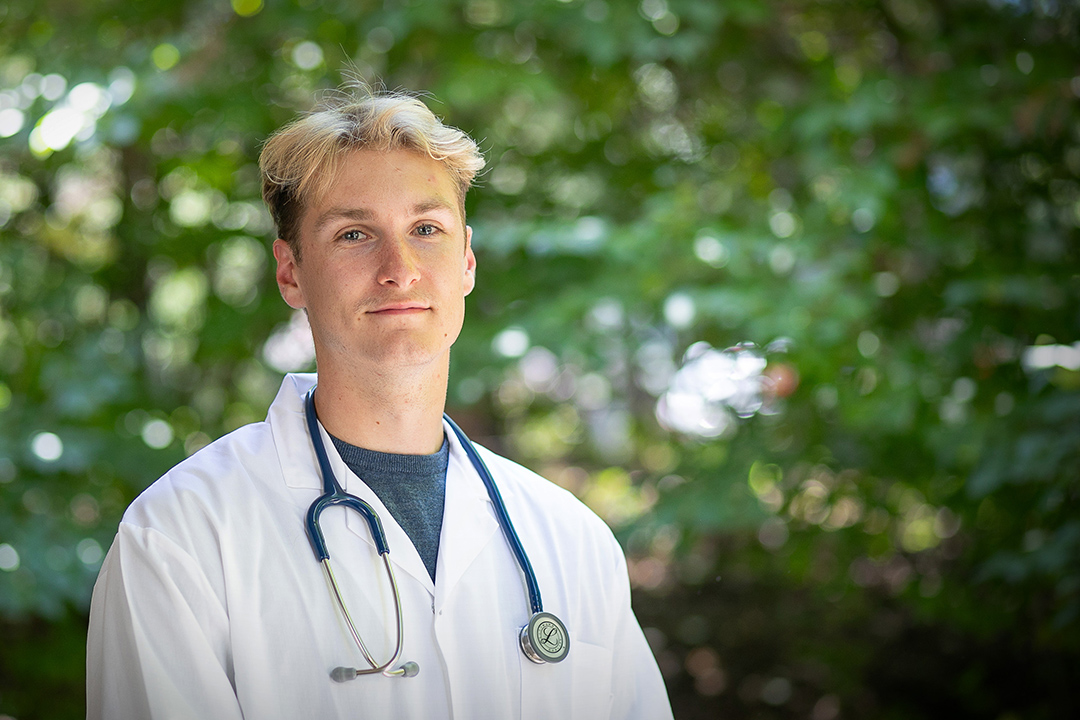
B.C. veterinary student follows interest in marine mammals from coast to coast
Chad Steverding, a first-year veterinary student at the Western College of Veterinary Medicine (WCVM), was passionate about all kinds of animals while growing up in North Vancouver, B.C.
By Lynne GunvilleBut it was during his summer vacations on Vancouver Island when marine mammals shot to the top of Steverding’s list of favourites.
His interest prompted countless visits to the Vancouver Aquarium to observe and learn more about them. While completing his Bachelor of Science degree at Dalhousie University (DalU) in Halifax, N.S., Steverding’s curiosity about marine mammals intensified along with his interest in veterinary medicine.
One of the connections he made while living in the Maritimes was Dr. Pierre-Yves Daoust (DVM, PhD), a veterinary pathologist and professor emeritus at the University of Prince Edward Island’s Atlantic Veterinary College (AVC).
“My first time assisting on a necropsy with Dr. Daoust profoundly solidified my drive to pursue veterinary medicine,” recalls Steverding, who later accepted Daoust’s invitation to tour the AVC and observe additional marine mammal necropsies.
“The first time seeing a veterinary college in person allowed me to see just how diverse the field [is]. I have a distinct memory of searching the courses taught at the WCVM on the drive back from Charlottetown to Halifax.”
During his undergraduate program, Steverding worked as a lab technician-data analyst in a Nova Scotia-based marine and geochemical oceanography lab led by Dr. Carolyn Buchwald (PhD). He also became involved with the Whitehead lab and the Cape Breton Pilot Whale Project, a long-term study of the social structure and vocalizations of long-finned pilot whales located off the coast of Cape Breton Island, N.S.
Steverding’s work with the Whitehead lab resulted in two subsequent studies of other cetacean species. While his first project focused on the social behaviour of beluga whales, the second project linked sea surface temperature to the development of epidermal diatoms (single-celled algae) on northern bottlenose whales.
“Post graduation, I worked with another undergraduate student to expand this project to include other possible factors impacting diatom growth, such as social behaviours, and how these behaviours are a possible form of bodily maintenance for this population,” explains Steverding.” We’re hoping to have this paper published in Marine Mammal Science.”
While awaiting acceptance to the WCVM, Steverding returned to the West Coast where he rejoined the Vancouver Aquarium (VA) and the VA Marine Mammal Rescue Society, this time as an employee — a water quality technician on the veterinary team.
“Working on a team with such talented and dedicated people made it all so much easier,” he says. “The experience that always stand out for me would be assisting with the rehabilitation of the rescued northern sea otter pups, Tofino and Luna.”
Steverding moved to Saskatoon last August to begin his veterinary studies at the WCVM. When he has time, he enjoys outdoor activities including skiing and trail running. During the pandemic years, he also took up a new interest and gained skills in luthier (stringed instrument) work. With his father’s help, he built his own bass guitar.
Since Steverding is unsure of the veterinary career path ahead of him, he’s spending his first year exploring all aspects — especially those that are unfamiliar to him.
“If I had to choose one at this very moment, I am most interested in pursuing a career in wildlife veterinary medicine,” says Steverding, who also points to an interest in rural veterinary medicine.
“While I don’t know what path of veterinary medicine I will take, [in five years] I hope to be working in the field competently and confidently — and making a difference in my community.”
Together we will support and inspire students to succeed. We invite you to join by supporting current and future students' needs at USask.