

WCVM professor recognized for leadership in cattle health
According to Dr. Murray Jelinski (DVM), the Western Canadian Association of Bovine Practitioners’ (WCABP) organizing team typically gives a “head’s up” to the recipient of its prestigious Bovine Veterinarian of the Year Award to avoid surprises.
By Cat ZensSo when Jelinski heard his name announced at the association’s annual conference on Jan. 15 in Calgary, he was shocked.
“[I was] kind of looking around the room thinking, ‘I wonder who’s going to get the award today?’” recalls Jelinski, a professor in the Department of Large Animal Clinical Sciences at the Western College of Veterinary Medicine (WCVM). “And then they started reading out part of my bio and I went, ‘Oh. Okay. That’s a shock — that’s a surprise.’”
Presented jointly by the WCABP and Boehringer Ingelheim, the annual award recognizes a veterinarian who has advanced bovine health and demonstrated leadership in the veterinary profession and cattle industry in Western Canada.
“I was quite humbled to receive [the bovine veterinarian of the year] award, especially from this group, because I've been so engaged with them for over 20 years,” Jelinski says.
The longtime professor and researcher has served as the WCABP’s treasurer and secretary for over two decades, and in a full-circle moment, Jelinski received the same WCABP honour for which he has previously nominated fellow veterinarians.
In recognition of his many contributions to veterinary education, the WCABP also established the Dr. Murray Jelinski Scholarship Fund. The new fund will support bovine-focused externship costs for fourth-year students at the WCVM and the University of Calgary Faculty of Veterinary Medicine.
Drs. Cheryl Waldner (DVM, PhD) and Nathan Erickson (DVM), two of Jelinski’s colleagues in the WCVM’s Department of Large Animal Clinical Sciences, nominated him for the award. Waldner has witnessed the impact of Jelinski’s work in research, teaching and mentorship, and both she and Erickson (one of Jelinski’s former graduate students) wanted to ensure that his contributions were recognized.
“His research has had a profound impact on clinical practices, his mentorship has shaped the careers of countless students, and his leadership has helped guide the veterinary profession through critical challenges,” Waldner says.
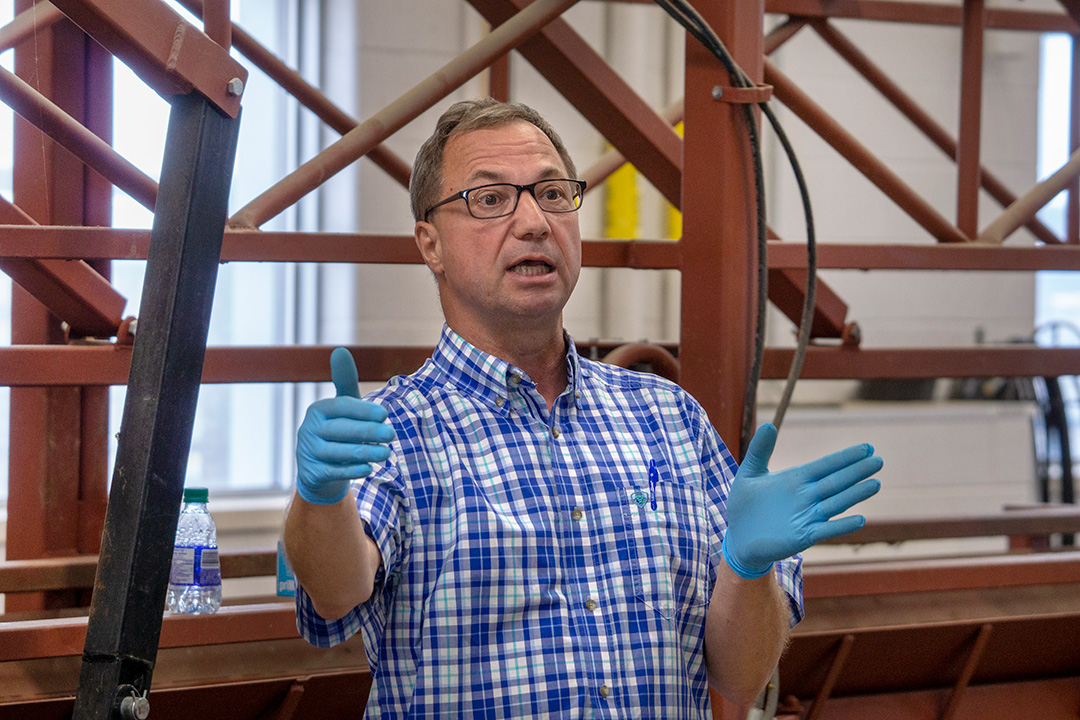
In September 2025, Jelinski also received the JJ Murison Distinguished Veterinary Award from the Saskatchewan Veterinary Medical Association — the organization’s highest honour for its members.
Born and raised in Regina, Jelinski grew up around farms and worked as a summer student for a swine producer in Turtleford, Sask., before finishing school. Once he decided on veterinary medicine, a career path in food animal health was an easy fit for Jelinski.
He earned his Doctor of Veterinary Medicine (DVM) degree from the WCVM in 1985. At a time when mixed animal positions were more difficult to find, Jelinski started his own veterinary practice in Moosomin, Sask., shortly after graduating. He practised in rural Saskatchewan for seven years, then returned to the WCVM in 1992 to complete a master’s degree in herd medicine. His graduate research work focused on the epidemiology of abomasal ulcers in beef calves — an uncommon but frustrating syndrome that often affects the best calves in a herd.
After several years working in the veterinary pharmaceutical industry, Jelinski returned to the WCVM in 2006 as a professor and the Alberta Chair in Beef Cattle Health and Production Medicine — a role he continues to hold.
In this research-driven position, he has led projects examining cattle diseases such as Mycoplasma bovis (M. bovis) and toe-tip necrosis, as well as demographics of the veterinary profession in Western Canada.
Jelinski is particularly proud of his work in M. bovis, a bacterium that can cause diseases such as pneumonia and arthritis in cattle. When he first began investigating the issue about a decade ago, there was limited literature on the topic. But since then, the research has significantly evolved and Jelinski’s work continues to be cited by scientists around the world.
“We made a significant contribution to the literature at a time when a lot of people weren’t engaged in it,” he says.
Jelinski is also investigating veterinarian shortages in Canada — a challenge that’s particularly common in rural communities across the country. While increasing the number of veterinary graduates in Canada may help, he says retention is key with mentorship playing a critical role.
“[A lack of mentorship] is a really important reason why students leave veterinary practices,” says Jelinski. “They lack mentorship, and we all have it in us to be a mentor, but the students also have to be able to step up to want to be a mentee.”
Over the years, Jelinski has mentored many students while continuing to seek guidance from his own mentors, Drs. Grant Royan (DVM) and Hugh Townsend (DVM), who are both WCVM alumni.
“You’re never too old to have a mentor, and you should have multiple mentors throughout your career,” Jelinski says. “I think as a mentee, you can avoid so many mistakes by just asking somebody who’s already made those mistakes.”
From teaching veterinary business classes and guiding student research on bovine disease to speaking at conferences and serving as a trusted resource for academic and political leaders, Jelinski’s efforts over the past four decades continue to have a lasting impact on the veterinary profession as well as Western Canada’s agriculture industry.
“Dr. Jelinski’s legacy will continue to inspire and benefit veterinary professionals and cattle producers for many years to come,” Waldner says.