
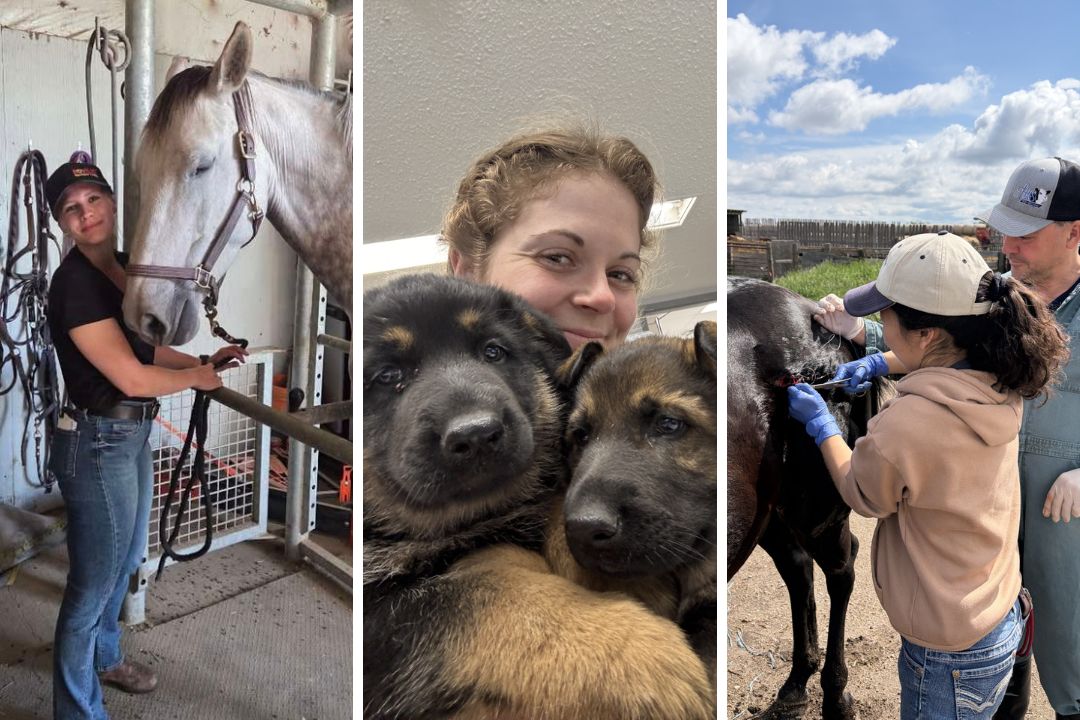
Veterinary students gain experience through new primary care rotation
When Brittany Todoruk walked through the doors of the Ste Rose Veterinary Clinic this spring, it felt like déjà vu for the Western College of Veterinary Medicine (WCVM) student.
By Cat ZensOne year after working as a summer student at the mixed-animal practice, Todoruk returned as a senior veterinary student to complete a four-week primary care experience at the clinic in Ste Rose, Man., this spring.
“It helped going to a clinic that I had already been at previously because they have seen me work and let me do a lot of work, so they built on that during my primary care [experience],” said Todoruk.
This spring and summer, she and her 87 classmates were the first veterinary students to complete the WCVM’s new “primary care experience” — a four-week rotation that aims to give them more hands-on experience with some of the everyday cases they will encounter in practice.
Altogether, 76 veterinary clinics in 61 unique communities across British Columbia (B.C.), Saskatchewan and Manitoba hosted one (or multiple) veterinary students for the new rotation.
During the month-long experience, the students worked alongside veterinarians, managed routine cases and developed skills in client communication and clinical decision-making.
This new rotation will help students build the practical skills and confidence needed to transition into veterinary practice, said Dr. Steve Manning (DVM), the WCVM’s associate dean of clinical programs. He oversees the primary care experience rotation along with other clinical rotations and externships that senior students take in the final year of the college’s four-year Doctor of Veterinary Medicine (DVM) program.
“I’m hopeful that it will make our graduates a little more prepared on day one … in a veterinary practice, which is where most [of the students are going after graduation],” he said.
The rotation’s creation was prompted by new requirements established by the American Veterinary Medical Association’s Council on Education, the accrediting body for all veterinary schools in North America. Starting in 2026, the council made it mandatory for all accredited schools to offer a 40-week clinical year. This change meant that the WCVM had to increase the length of its DVM program’s fourth year from 32 to 40 weeks.
Four of these additional weeks will be filled with elective rotations in the WCVM Veterinary Medical Centre, said Manning. As the college considered how to assign the remaining four weeks, faculty members reviewed feedback from recent WCVM graduates and their employers. One common message stuck out: students wanted more opportunities to work with the day-to-day cases that make up the foundation of veterinary practice, from wellness exams and vaccinations to dental check-ups and preventive care.
While the WCVM had been considering implementing such a program for some time, the extension of the veterinary program’s fourth year created an opportunity to incorporate this experience into the curriculum. The community-based rotation allows students to immerse themselves in the work of a veterinary practice for longer than the standard two-week clinical rotation.
Students could secure placements with clinics they were already familiar with or apply to participating practices. More than 90 clinics across the college’s three partner provinces expressed interest in hosting students, said Manning.
Building confidence through experience
For Abigail Cunningham of Smithers, B.C., the rotation allowed her to develop practical skills and professional confidence.
She completed her placement at Green Mobile Veterinary Services in Prince George, B.C. Eager to work in a rural mixed-animal practice after graduation, Cunningham viewed the placement as a chance to experience the type of career she hopes to pursue.
“It was huge to have a four-week rotation and not just two weeks because I got to build a strong relationship with the vet and staff,” she said. “I also got a really good view of what mixed animal practice in rural B.C. looks like because that’s what I’m planning on doing.”
Cunningham was mentored by Dr. Jodyne Green (DVM), the clinic’s owner and a WCVM graduate. According to Green, the extended placement allowed Cunningham to progress from observing appointments during her first week to taking on independent responsibilities.
“[Dr. Green] would quiz me on lots of questions, which I really appreciated. I was pushed to know things but also given time to research,” said Cunningham. “I still have so much to learn, but I gained a lot of confidence.”
Green emphasized that the four-week format provides students with enough time to become comfortable in the clinic and to apply their knowledge in meaningful ways.
“When you start to get comfortable with somebody, the two weeks is over and they’re moving on to their next rotation,” she said. “With the four weeks, you can expand and really encourage a greater learning experience.”
Green described Cunningham as an enthusiastic and knowledgeable student who made the most of the four-week placement.
“We were happy to give her the opportunity to continue to grow and make a successful transition from student life into veterinary post-graduation life,” said Green.
Learning the art of veterinary medicine
WCVM student Lynka Itogawa said that the primary care experience offered her a different perspective on veterinary practice.
Itogawa, who grew up on a cattle ranch near Stoughton, Sask., completed her rotation at Outlook Veterinary Clinic in Outlook, Sask., where she worked under the mentorship of Dr. Carmen Millham (DVM), a WCVM alumnus. She also spent time learning from Dr. Tressa Morris (DVM), one of the college’s recent graduates.
“The two vets were really good at teaching and letting me get to do things [on my own],” she said.
Working alongside two veterinarians at different stages of their careers gave Itogawa insight into the technical and interpersonal sides of veterinary medicine.
She recalled Millham telling her that while veterinary students often graduate with a strong understanding of science and physiology, experienced practitioners can teach “the art of vet."
“This includes aspects like client communication, staying clean, time management — those kinds of things,” said Itogawa. “There are going to be cases and clients that are not following textbooks, so he gave me insight into how to manage those sorts of pieces.”
Like Cunningham, Itogawa appreciated the length of the rotation, saying the additional time allowed her to become part of the clinic’s team and see the realities of everyday practice.
"Primary care is a really good experience because you never know what you're going to get through the door, so you've got to be on your feet," she said.
Expanding on existing skills
For Todoruk, her primary care experience at Ste Rose Veterinary Clinic provided an opportunity to build on clinical skills she had developed while preparing for a career in large animal medicine.
Originally from western Manitoba and currently living on a cow-calf operation, Todoruk hopes to join a mixed-animal or large-animal practice once she graduates from the WCVM in June 2027.
During her placement, she participated in various procedures from horse castrations and dental procedures to conducting semen tests on bulls. Beyond the technical skills, Todoruk said one of the most valuable lessons was learning how to communicate effectively with clients.
“Clients were always very excited to hear that I was a student from the area and I’m looking to come back [to work] in that area,” she said. “It was a good learning curve on how to properly communicate with clients, especially in harder situations.”
Todoruk credits her supervisor and WCVM alumnus, Dr. Kevin Steinbachs (DVM), with creating a supportive environment that encouraged her to think independently and apply what she had learned in the classroom.
The experience also gave her confidence heading into future clinical rotations and eventual practice.
“It makes me feel much more at ease,” she said. “I can comfortably go into my career knowing that if a C-section (caesarean) comes in, I’m not going to be second-guessing myself. Like I’ve done it. I know what I’m doing.”
Together we will support and inspire students to succeed. We invite you to join by supporting current and future students' needs at USask.