
Peak posture: USask study uses AI tool to target ergonomic risks for veterinarians
An artificial intelligence (AI) tool designed to assess ergonomic risks may help large animal veterinarians stay healthy — and longer — on the job.
By Lucas HorsmanThe dangers of poor posture aren’t typically included in veterinary students’ training, but Dr. James Carmalt (VetMB, PhD) knows from experience that the risk for ergonomic injury is high for veterinarians who work with horses, cattle and other large animals.
“Physical injury or wear and tear is the cause of a substantial portion of large animal vets leaving the profession early,” said Carmalt, a professor of large animal surgery at the Western College of Veterinary Medicine (WCVM). “Rotator cuff and back injuries are extremely common in large animal medicine.”
Carmalt and his WCVM colleague, Dr. Monique Mayer (DVM), have partnered with Drs. Niels Koehncke (MD) and Angelica Lang (PhD) from the University of Saskatchewan’s College of Medicine to examine a potential solution to this issue. It’s an AI program called TuMeke Ergonomics that can analyze videos of veterinarians during procedures and provide them with feedback about their posture.
Mayer used a similar AI program in a study investigating the ergonomic strain of portable X-ray machines on veterinarians. During that study, she also realized how many people in the veterinary profession were struggling with ergonomic strain injuries.
“We started by looking at how people crouched and stood during our research with portable X-ray machines,” she said. “Then we had people start talking to us about musculoskeletal disease from their work. We started to question how we could investigate that.”
Supported by the WCVM Townsend Equine Health Research Fund, this study is among the first to examine the merits of ergonomics AI in equine veterinary practice. The program’s potential is intriguing to Carmalt who knows how often large animal veterinarians place themselves in harm’s way.
“You try and do the job but also give yourself room to escape,” he said. “[When] I go to pick up the hind leg, I know my posture is poor but that’s only because I’m trying to protect myself if the animal kicks out. You’re making a compromise between getting the job done and your body posture.”
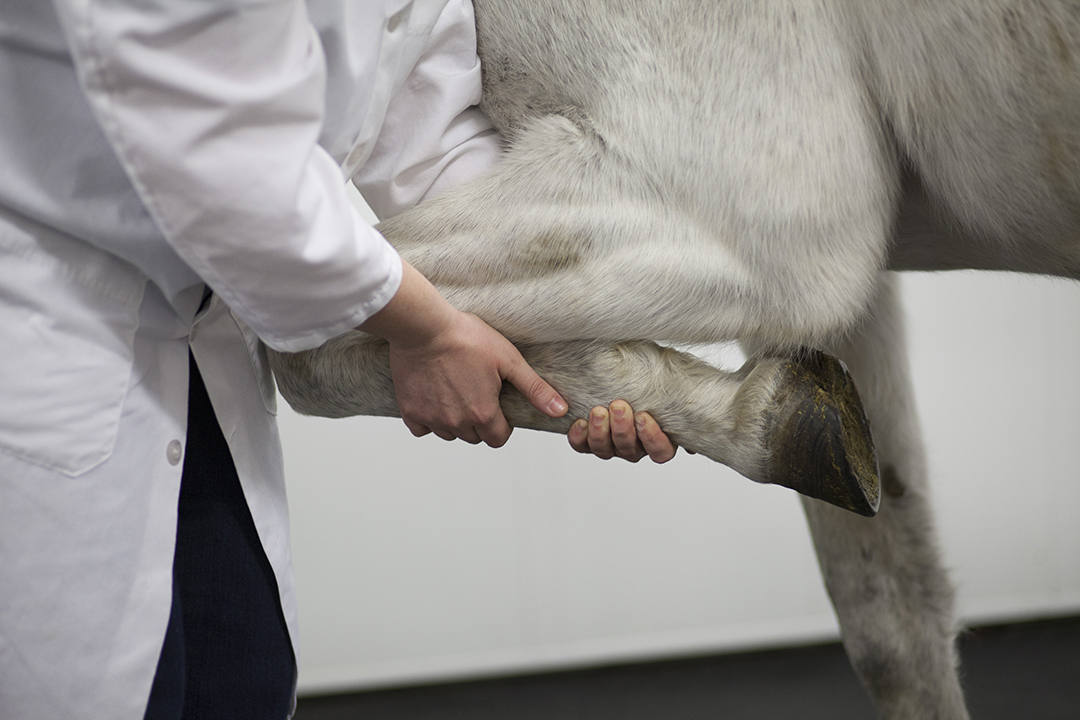
Carmalt and Mayer are focusing on lameness exams because of its abnormally high ergonomic risk. During the diagnostic procedure, the veterinarian evaluates the animal’s gait at a distance by observing how it distributes the weight on each limb and if the horse shows signs of lameness. The clinician then performs flexion tests, picking up each of the horse's limbs and placing additional pressure on particular joints to isolate painful areas.
The flexion test is the most concerning step for Carmalt and his colleagues.
“The problem is you have an animal that is in pain and doesn’t want you anywhere near the painful bit,” he said. “They’ll pull away or kick out at you.”
The amount of weight that veterinarians have to support during these exams can also vary greatly.
“The horse may hold its own leg up when you are settled into the flexion, which weighs only about two per cent of its body weight (or 10 kilograms for a 500-kilogram horse). Then without warning, they’ll shift their weight and you get an extra 20 kg ... the unpredictability is the biggest risk factor,” said Carmalt.
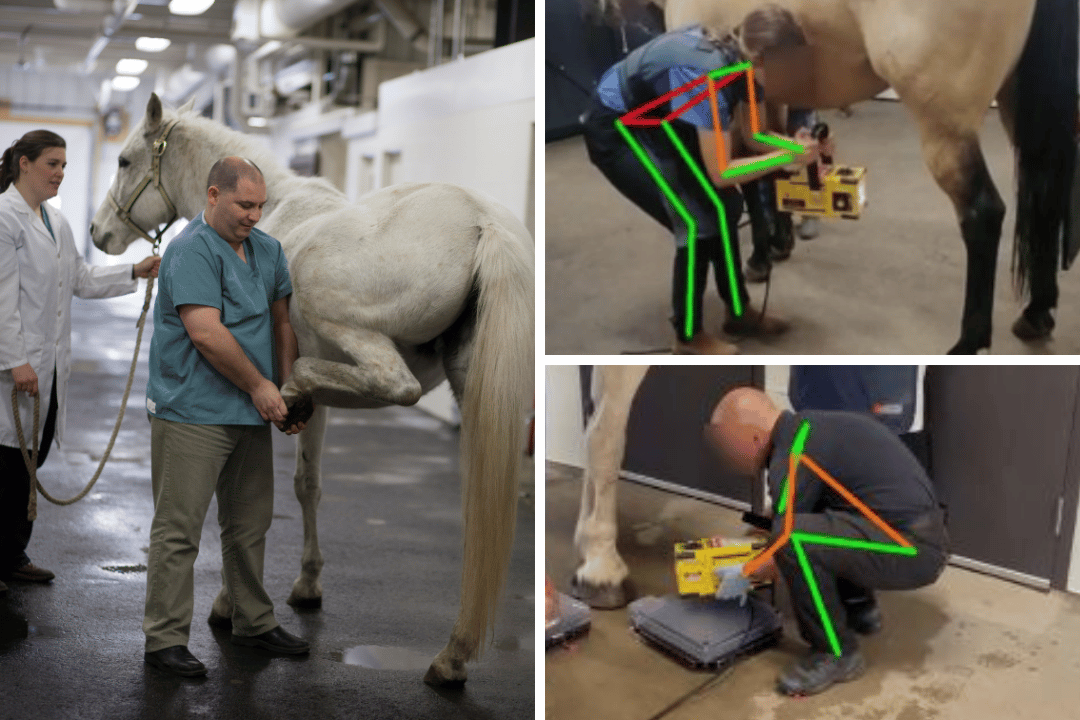
In the WCVM study, researchers will record veterinarians performing lameness exams, then upload the videos to TuMeke’s three-dimensional ergonomics assessment program (Risk Suite).
The program analyzes each video, then places a small visualization of the veterinarian’s skeletal system over top of their body, with separate parts representing arms, back and legs. When the program detects poor posture, the colour of affected body parts changes.
The process is largely automatic, as the only manual input required is the weight being handled by the veterinarian. It’s measured using a sling — like a luggage scale — that the horse’s limb can be placed in.
Ease of use was one of the primary reasons that the team chose TuMeke for the project over other AI programs built to assess ergonomics in different occupations, Mayer said. The platform is also consistent with its readings, usually giving scores that are similar to those of ergonomics experts.
Carmalt and Mayer are optimistic that their findings will create more opportunities to protect current and future veterinarians from ergonomic strain.
“We’re hoping to come up with suggestions about the body positions that clinicians can assume during flexion tests,” Carmalt said. “Every flexion test has a variety of body positions you could be in. We want to say, ‘If you are going to do a flexion test of the horse’s carpus, this is the most ergonomic position.’”
Mayer hopes that studies like this one will validate the need for targeted ergonomic training in the Doctor of Veterinary Medicine (DVM) curriculum: “I think people are aware that it’s there, but they don’t learn about ways to mitigate it ... here we’re going to identify it, quantify it and hopefully raise awareness.”
Carmalt also sees the potential for similar research highlighting other large animal veterinary procedures such as rectally palpating cows to detect pregnancy or collecting semen from bulls to evaluate breeding soundness.
“Cow vets check 400 to 600 cows a day, using both arms, up to their shoulders. If the cow moves, now you’re rotating at the shoulder — and bovine vets have a lot of rotator cuff issues as well,” he said. “As that it is a relatively controllable, highly repetitive motion, you could probably do something.”
Together, we will undertake the research the world needs. We invite you to join by supporting critical research at USask.