
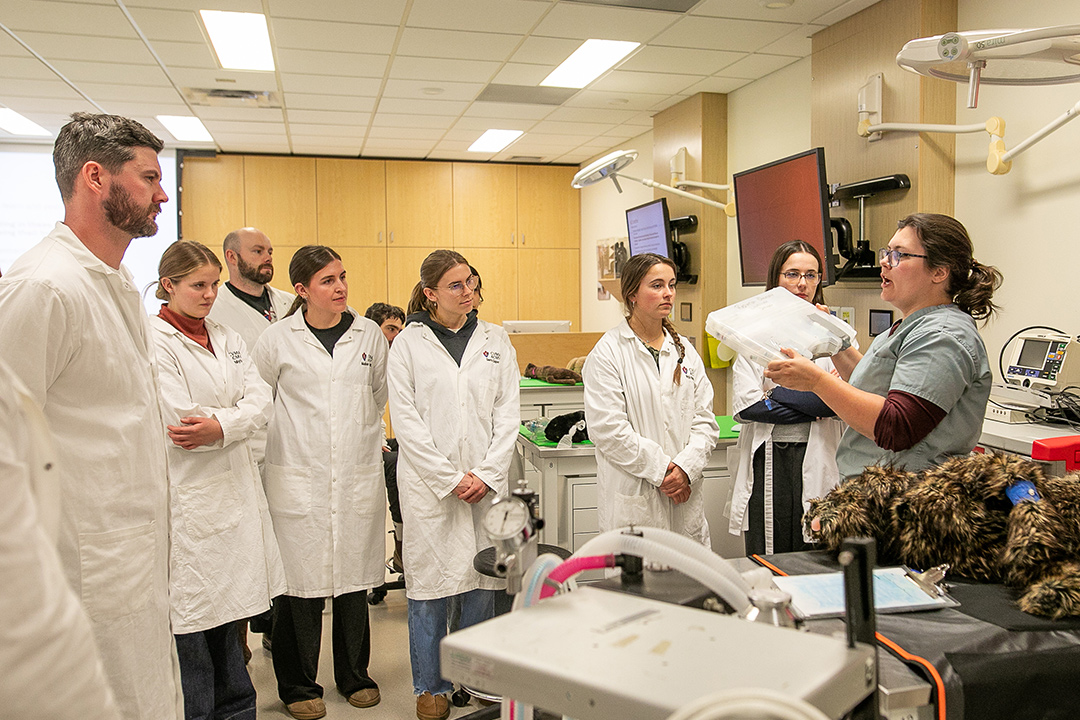
USask assessment champion explores new teaching tools for WCVM
Dr. Jen Loewen (DVM) enjoys pushing boundaries in teaching, and her role as a University of Saskatchewan (USask) assessment champion provides her the opportunity to do just that.
By Kira GlasscockUSask assessment champions are educators who use innovative and effective assessment practices in their teaching. The Gwenna Moss Centre for Teaching and Learning established these champions to help support other educators on campus as they navigate assessment challenges and prepare for the Course-based Assessment of Student Learning Policy, which takes effect in fall 2027.
Loewen, who is one of 12 assessment champions in the 2026 cohort, is an associate professor at the Western College of Veterinary Medicine (WCVM) and a board-certified specialist in emergency and critical care at the WCVM’s Veterinary Medical Centre.
“Assessment tells me how the learners are doing with the content that I'm providing, but it's also a way, depending on the type of assessment, to see if the information that I'm providing my students is actually helping them learn the content that I want them to learn and to grow in their competencies and proficiencies,” said Loewen.
With the development of new technologies and evolving student needs, educators like Loewen are adapting assessment practices to better support student learning and success. For her project, Loewen is using interactive branching scenarios that let students test their knowledge and practise decision-making in a low-stakes environment.
The online case scenarios walk students through medical situations they might encounter in veterinary practice. The interactive activities feature support characters, including registered vet technologists named “Judy” and “Joe,” who prompt students to make decisions and provide immediate feedback.
“Students critically think, ask questions, justify decisions and negotiate as the scenario shifts like a ‘choose your own adventure,’” said Loewen, who graduated from the WCVM in 2014 and completed a Master of Education in Health Professional Education at USask in 2024.
When students make decisions in the scenario exercises, they find themselves asking questions that they didn’t realise they had, said Loewen.
“It's one thing to answer a question, get it wrong and not know why I got that wrong, compared to if Joe or Judy can say, ‘Hey, don't forget the algorithm says this,’” said Loewen. “Being able to justify that decision is equally as important as randomly choosing the right answer or the wrong one for helping build their knowledge.”
The fictional characters are only tools, but students “often have big responses” to feedback from them, said Loewen. “In the classroom, I hear students say, ‘Oh dang it, Judy, why are you showing up again?’ knowing that maybe their choice wasn't the best option and that they should have made another decision.”
Loewen noted that emergency medicine is a common area for students to “freeze up” due to panic and stress in a fast-paced environment.
“Something that I've learned through my own Master of Education program is that right now we often think of stress as a negative, but you need some type of stress or stimulus to learn,” said Loewen. “That line between distress and eustress (good stress) is different for every person, but I think scenarios like these using technology can help students learn in a less stressful, safer environment that puts them in real-world situations that they can practise.”
Loewen uses the branching scenarios for non-graded formative assessment, but based on positive student feedback, she hopes to eventually incorporate more scenarios into her classes.
For Loewen, being an assessment champion has been a great opportunity to learn what others across campus do to assess student learning.
“USask is a unique place in that it has all the health professions in one place, but there are other colleges outside of the health professions that we could probably learn from in terms of different aspects of assessment that they're using,” said Loewen, who is enthusiastic about the program’s outcomes.
“I think it’s great that we’re being more diligent and probably purposeful in terms of how we're aligning our courses and our assessments for our learners.”