
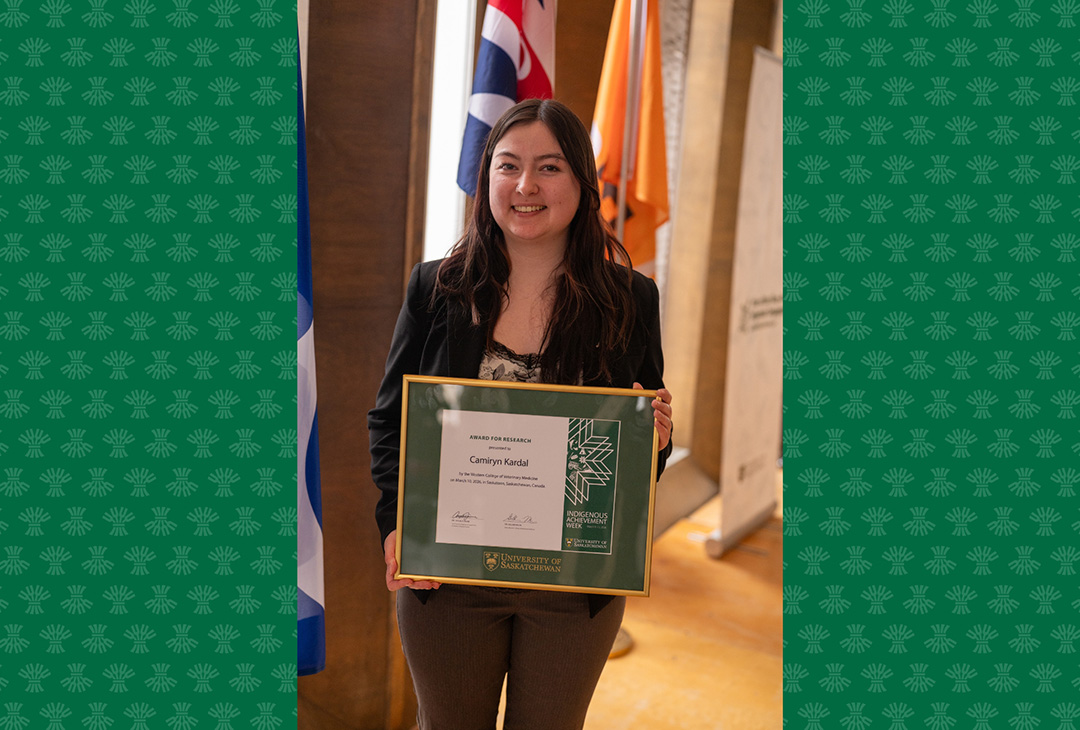
Métis student recognized with Indigenous Achievement Award for novel research project
The Western College of Veterinary Medicine’s (WCVM) graduate studies program attracts students from all different backgrounds — not just from veterinary medicine.
By Jessica Colby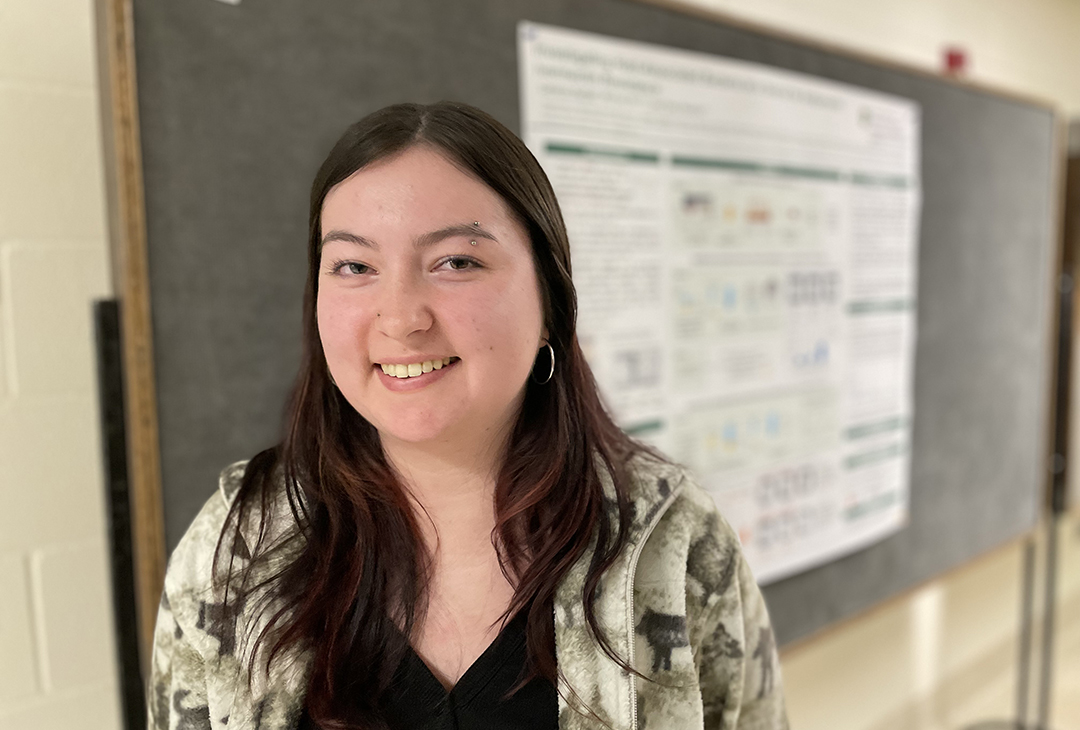
“Only about half of our research that we produce fits in the veterinary area,” says Dr. Lynn Weber (PhD), the WCVM’s associate dean of research and graduate studies. “The rest is largely agricultural, and we do have a significant chunk that is actually more related to human health.”
These graduate students include Camiryn Kardal of Saskatoon, Sask. Before beginning her master’s program, Kardal completed a Bachelor of Science (honours) in toxicology at the University of Saskatchewan (USask) in spring 2025. She hadn’t thought about embarking on a graduate program until she began conducting research, but once she started, the lab quickly became her favourite place.
“Finding an interesting project makes it easy to be excited about learning,” says Kardal, whose graduate supervisors are WCVM faculty members Drs. Michael Wu (PhD) and Tony Ruzzini (PhD).
Kardal was recently awarded one of the USask Indigenous Student Achievement Awards in the research category. She received her award at a ceremony held on March 10 during the university’s annual Indigenous Achievement Week.
“The award ceremony was a wonderful celebration of Indigenous achievement that I feel lucky to have been a part of,” says Kardal, who is of Métis heritage. “This award validates the work I’ve put into my research and my career as a student.”
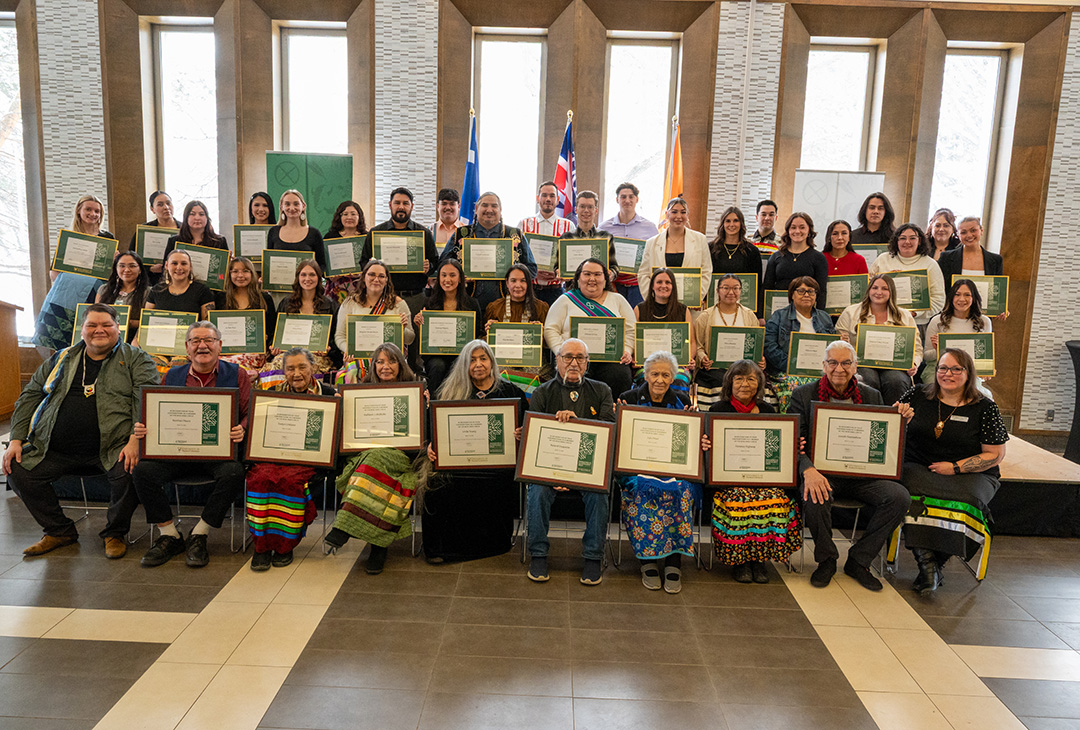
The USask Indigenous Achievement Awards are presented annually in five categories: academic excellence, community engagement, leadership, research and resiliency.
“It’s important to reconnect with the culture since so much has been lost,” says Kardal, noting that her Indigenous ancestors were forbidden from practising their cultural traditions. “Embracing and reclaiming the culture helps to heal from the past.”
The research awards are reserved for students who have undertaken innovative or new research projects in undergraduate research programs or graduate studies at USask. Kardal’s project is a novel one: she’s examining how bacteria may affect the effectiveness of ivermectin, an antiparasitic drug regularly used by veterinarians to treat various parasites in cattle, horses and other livestock.
Veterinarians use ivermectin to treat internal parasites — such as those found in the digestive system of animals — and external parasites that live on their skin.
“The element of discovery and the novelty of the project are the most alluring parts for me,” she says.
Unfortunately, antiparasitic drug resistance is a growing concern in the veterinary profession as more parasites become resistant to a small pool of commonly used antiparasitic medications.
“Antiparasitic resistance has wide implications in agriculture, so I hope my work can positively contribute to food security and sustainability,” says Kardal.
Using a model roundworm known as Caenorhabditis elegans (C. elegans), which are safer to work with than parasitic worms, Kardal is studying bacteria associated with cattle due to the growing concerns of antiparasitic drug resistance in the food animals.
“Some parasites can develop tolerance toward drugs like ivermectin, which can slow down production and cause economic losses,” says Kardal. “If bacteria can further alter ivermectin and make therapies even less effective, we need to understand these effects to be able to control them.”
Kardal hadn’t heard of the university’s Indigenous Achievement Awards for research and was surprised to learn that her graduate supervisors had nominated her earlier this year.
“It showed me how they are invested in my success and are supportive of me as an Indigenous student,” says Kardal, who is grateful for the support of her supervisors. “I am appreciative that they recognized the work I have put into my research.”
The WCVM graduate studies program is a diverse one that reflects the many disciplines and interests in veterinary medicine and One Health. Each of the college’s five departments have master’s and PhD pathways, plus the college’s two clinical departments offer programs combining graduate studies and clinical residencies in various veterinary specialties.
Graduate students based at the WCVM are also diverse in backgrounds, with students hailing from more than 30 countries around the world. Weber emphasizes the importance of having a diverse graduate student population at a veterinary college that serves three of Canada’s western provinces — British Columbia, Saskatchewan and Manitoba.
“We try to encourage Indigenous students to come and experience research through their undergrad [in summer research] or encouraging anyone who wants to continue on to graduate-level research,” says Weber.
For Kardal, engaging with her community and learning traditional ways from elders are especially important in connecting with her Indigenous culture. It’s also about connecting with the land and learning more about her history.
“When I was told that I had received the award, I felt proud that I could represent the university as a recognized Indigenous researcher,” says Kardal.
Together, we will work towards Truth and Reconciliation. We invite you to join by supporting Indigenous achievement at USask.