
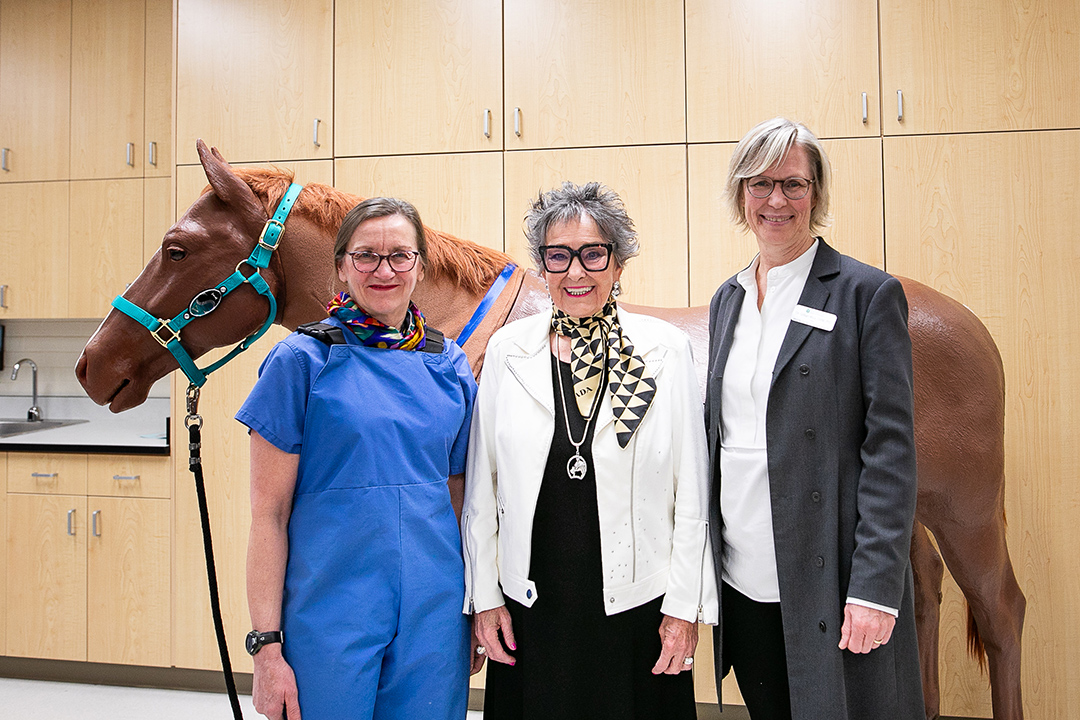
Card earns top USask honour for her work in improving lives of animals and people
After decades of supporting the lives of animals and people, Dr. Claire Card has reached a milestone achievement in her career that spans nearly four decades.
By Cat ZensCard (DVM, PhD) is one of five University of Saskatchewan faculty members to receive the honorary title of distinguished professor in 2026. This prestigious honour recognizes professors who have made lasting contributions to teaching and research.
Since Card joined the WCVM faculty in 1991 as a theriogenologist (reproduction specialist), she has been a teacher and mentor for many veterinary students. She has also supervised dozens of clinical interns, residents and graduate students.
Then there is Card’s research, which focuses on equine and food animal reproduction. She has explored a wide range of related topics, including congenital hypothyroidism dysmaturity syndrome in foals, hormone regulation in horses and the fertility of frozen semen.
In addition to her busy clinical work in the equine reproduction service at the college’s Veterinary Medical Centre (VMC), Card has been a partner in global development projects through Veterinarians Without Borders-Vétérinaires sans Frontières (VWB-VSF) for more than 20 years. Her most recent effort is the One Health Community Partnerships project, a five-year, $4-million global health initiative that assists women and families affected by HIV and AIDS in Uganda, Ghana and Ethiopia.
Q. Many WCVM faculty members nominated you for the distinguished professor title. How does this support make you feel?
I’m very humbled by the award. There’s no way for someone like me to be successful in research, teaching and clinical work, and [then] getting on a plane and going to Africa every year without the support of the people that I work with. I couldn’t be “Claire” without their help.
Dr. Steve Manning (DVM) has always been very helpful: he supports our work and has been a great collaborator. There are so many other people here … who have been fabulous collaborators — everything from basic science to clinicians. It takes a village to raise a scientist, but I’ve got a lot of support from many people.
Q. What sparked your interest in horses?
As a child, I had gone through the horse 4-H program, so I had spent time working with horses as a young rider, and we used to show quarter horses. I didn’t own my own horse, so I had a knack for convincing people who had horses that needed some work to allow me to ride and work with their horse so I could get in extra riding.
Q. How has leading the One Health Community Partnerships project shaped your perspective?
Since the early 2000s, we've been going to Uganda and working with rural HIV- and AIDS-affected families. That kind of work has made meaningful impact for the lives of their people, specifically women and girls in rural areas. Our recent funding from Global Affairs Canada allowed us to extend the work from Uganda into Ghana and Ethiopia.
I believe that all of us should try to make the world a better place. A single person can have an impact. Understanding poverty is something that I think we could do more work in veterinary medicine and in helping people understand the connections of the structural factors that keep people poor. We should all be working to try to make the world a more fair, equitable place.
Q. Do you have a favourite aspect about your job as a professor?
I really like to help students, interns and residents become critical thinkers; I very much love to see them grow wings and fly. Producing qualified, confident veterinarians who are good with people, good with animals and have good skills is a very important aspect of what I do.
Q. How has your role as a mentor shaped your students and your teaching philosophy?
I like to treat our profession as a big family. I don’t want to be someone who spends a lot of time judging students — I’d rather support them and help them develop because every learner is different. I want them to feel that they could reach out to our [equine reproduction] service and me at any time.
I think it’s super important to understand that people do have difficult patches in their lives. As a profession, we’re all here to support each other and to acknowledge that we’re humans, and that sometimes things happen. You should be able to feel free to talk about it and feel supported by your colleagues and have the space and grace to make sure you know that you're going to make mistakes eventually.
Q. What’s your advice for future veterinarians?
You may not realize how important of a person you are as a veterinarian in a community. You have a specific leadership position in society, and you should try to use that role for good. I try to impart the message that we get farther faster when we work together, that we set good examples, and that we participate in making the world a better place.
Q. What’s one thing that has changed during your time at the college?
When I first came here, I would not have said that the WCVM was a very friendly place for women. It was just practice that men had an “old boys club” and the women weren't necessarily invited in.
Over the years, that has changed quite a bit. We now have the college’s first woman dean (Dr. Gillian Muir). We've had many female department heads, and the whole student demographics has changed, so we've continued to move with the times and adjust.
Q. What’s next for you?
I’m working on completing some of the research I’ve started, and hopefully, I’ll find a way to pass the torch to some very talented younger people and continue to help them as a professor emeritus.
I also aim to continue work as a partner in development with many of the people I’ve worked with over the years. I’m a social activist, so I see myself continuing to work in anti-poverty spaces, working on behalf of unhoused people and people with mental health and addictions issues.