

USask graduate student recognized for international research collaboration
Teaming up with her colleagues has allowed one University of Saskatchewan graduate student to realize her potential.
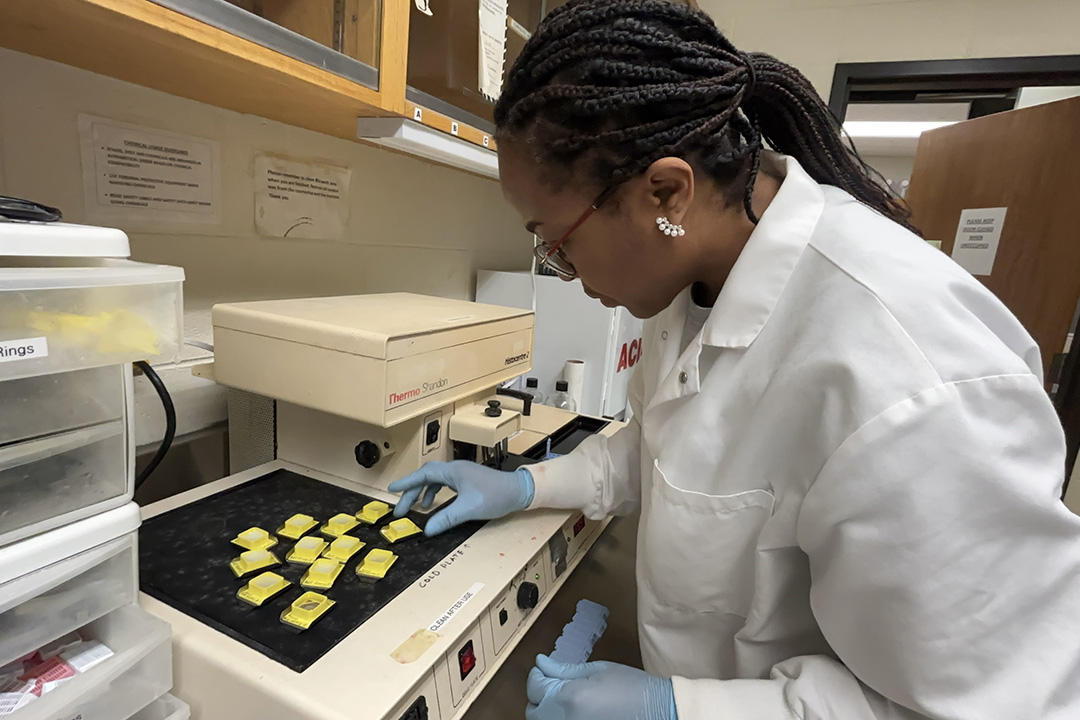
By Lucas HorsmanDr. Chinelo Uju (DVM) has become very familiar with the role that teamwork and networking plays in her career. In recognition of her contributions to the University of Saskatchewan’s (USask) international profile, Uju is the recipient of this year's Global Research Leadership Award for Students.
"What inspires me most about my work is the possibility of a discovery, a lesson or a mentoring conversation that can make a meaningful difference in someone's life and future," said Uju, who has been a USask graduate student based at the Western College of Veterinary Medicine (WCVM) for four years.
The Global Research Leadership Award for Students is presented annually by the USask International Office to students who have strengthened the university’s global reputation through exceptional research work and collaboration with local and international scholars and researchers.
Uju accomplished this goal by collaborating with scientists from Ottawa, Iran, Italy and Brazil on research projects that have resulted in peer-reviewed publications and presentations at scientific conferences. Some of this work was part of her PhD thesis that she successfully defended in May 2026 — Uju will receive her degree at the USask Fall Convocation in November 2026.
In addition to facilitating knowledge exchange, Uju believes that research collaboration is valuable for developing skills that may not be as readily cultivated through individual research.
“I remember working with a researcher from Naples who came up to me and said, ‘Oh, there’s a different way you could do this,’ and after he showed me, it was like a brand-new horizon for me,” said Uju.
“We also don’t make enough time to develop ‘soft skills’ like interpersonal relationships, communication skills and teamwork.”
Research collaboration has taught Uju the importance of being open to different perspectives. “You have to come out of your own thoughts and consider everyone else’s opinions.”
Pursuing complex and ‘complete’ science
Uju and her collaborators worked alongside WCVM professor Dr. Suraj Unniappan (PhD), whose laboratory in the college’s Department of Veterinary Biomedical Sciences was where Uju did her PhD work.
Uju’s research involved studying the role of growth factors in zebrafish reproduction. One of the growth factors that she examined is the brain-derived neurotropic factor (BDNF) and its presence in the reproductive tissues of the fish.
“We found that the presence of that molecule in the ovary is important for eggs to mature properly,” she said.
Uju’s interest in animal reproduction started at the University of Nigeria where she completed her Doctor of Veterinary Medicine (DVM) degree. She also enrolled in a master’s program to further explore that interest.
Additionally, Uju learned that she greatly enjoyed helping students understand complex concepts and applied to be a lecturer. "During my master’s degree program, I came in contact with undergrads whom I mentored during my teaching assistant role with my master’s supervisor," she said. "I quite enjoyed it, being able to explain something and seeing that lightbulb moment when the student gets it."
After her master’s degree, Uju began to feel that her education could be pushed even further.
"I felt I could do so much more and wanted to explore opportunities beyond what I had experienced back home. I knew there was more and I wanted that. I wanted to do complex and ‘complete’ science, in a place where the facilities and opportunities were available to support the work. I wanted a more fulfilling research experience."
This aspiration prompted Uju to begin looking abroad for more schooling, and during her search, she found USask.
"With USask, the options were vast. Coming from an agriculture background, there were a lot of areas I could go into," she said. "There was a vet school, health sciences, agricultural sciences — the options were numerous, almost like a little gem hidden somewhere."
Uju decided to pursue a PhD at USask (based at the veterinary college) and moved with her family to Saskatchewan. Although it was a big change, she said that she felt welcomed at the WCVM.
"I came in with my husband and kids, and we had nothing else besides our bags. Some members of my department rallied around and brought us supplies," she said. "They didn’t have to do that — they didn’t know me, we had never met before, yet they did. I’ll never forget that."
From catfish to zebrafish
Despite moving halfway around the world and coming into a new lab, Uju’s work was still centred on fish.
"I worked with African catfish for my master’s ... [and] because Dr. Unniappan is also a fish person, I thought, ‘Oh, this will be an easy transition for me,’" she said.
However, the zebrafish in Unniappan’s lab didn’t quite compare to the catfish that Uju was used to.
"We got to the fish room and when I saw how tiny they were — and these were adults — I panicked, thinking how I was ever going to study and dissect fish that small! Zebrafish can be quite useful for biomedical research, as some of their biology is quite similar to that of humans. They are also very good at adapting to genetic manipulations, which is becoming an increasingly large part of biomedical science.”
Uju’s research is in the field of reproductive endocrinology — the study of hormones that play a role in many different things such as growth and reproduction.
As global demand for animal protein continues to rise, the aquaculture industry is expanding to help meet this demand. However, reproduction rates often go down when fish are bred in captivity. By studying different factors that may influence reproduction, like the BDNF molecule, Uju hopes to improve the situation and contribute toward sustainable aquaculture.
Uju also believes that her findings may have potential applications for humans. If BDNF can promote the maturation of eggs in vitro, it could potentially support in vitro maturation (IVM), reducing the need for the hormone injections used to stimulate the ovaries before IVF (in vitro fertilization). BDNF could potentially become part of the culture conditions used to mature eggs before fertilization and possibly boost the rate of successful pregnancies.
In August 2026, Uju began a postdoctoral fellowship at the USask College of Medicine — an exciting opportunity to continue learning and growing toward being an independent researcher.
Her willingness to continue trying for greater things is something she attributes to one of her past teachers.
“A teacher once told me to never forget the power of ‘yet.’ She said instead of saying ‘I don’t know how to do this,’ say ‘I don’t know how to do this yet,’” Uju said. “Unless you try, you really don’t know what you can do. That is what this PhD has taught me.”
Lucas Horsman of Indian Head, Sask., is a journalism student at the University of Regina. Horsman was the WCVM’s summer research communications intern in 2026.