
A canine Mother's Day miracle
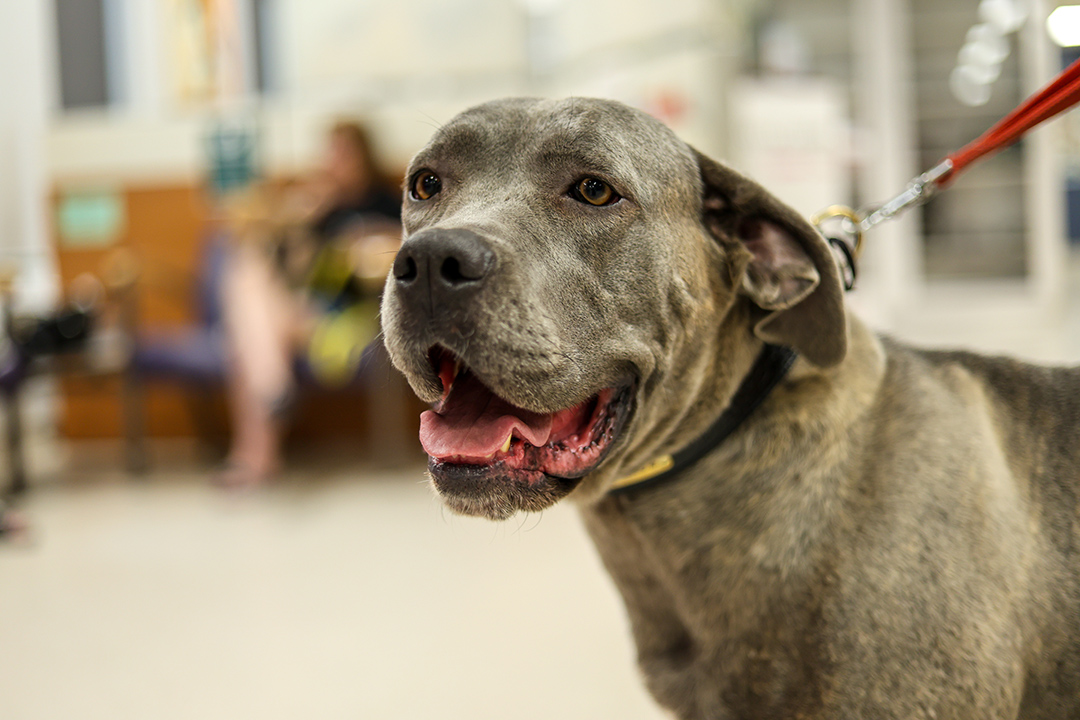
When Mother’s Day arrived this spring, a four-year-old cane corso dog named Omen knew it was time to give birth.
By Cat ZensThe canine mom successfully delivered nine adorable puppies after a late-night trip to the Western College of Veterinary Medicine (WCVM) Veterinary Medical Centre (VMC) and emergency surgery.
About three weeks earlier, Omen had been rescued by Jill Huber, who found the dog in poor condition; she was alarmingly thin, with her ribs and backbone clearly visible. When Huber brought her new dog her local veterinarian for a checkup, vaccinations and a spay procedure, there was an unexpected twist: Omen was heavily pregnant.
“[The veterinarian] told me that there were eight puppies in there, and they were coming in just under three weeks,” said Huber. “[At that time], I only had Omen for two days.”
Despite the surprise, Huber committed herself to giving Omen a safe, loving home. But when the dog went into labour on Mother’s Day and 26 hours with no progress, Huber recalled thinking “I don’t think she’s going to be able to push these babies out.”
After Huber took Omen to the WCVM’s veterinary teaching hospital, clinicians determined that the pregnant dog required an emergency caesarean section. There was concern that both Omen and her litter were in danger after the prolonged labour — at one point, veterinary staff warned that all the puppies might not survive.
On top of this already overwhelming situation, another challenge loomed: the cost of surgery. Huber, who works as a waitress, didn’t have the financial means to cover these unexpected veterinary expenses.
That’s when she learned about the WCVM’s Les and Irene Dubé Good Samaritan Fund. Established in 2011, this fund provides financial assistance for medical treatment at the VMC for animals that are ownerless or whose owners cannot pay for care due to circumstances beyond their control. In 2020, the fund was renamed in honour of the late philanthropists Les and Irene Dubé, who contributed $1 million to support its mission.
Dr. Vanessa Saraiva Sousa (DVM), a small animal rotating clinical intern at the college’s hospital, became Omen’s primary clinician following the birth. She has seen firsthand how the fund changes outcomes for pets and their owners.
“We can see the relief in their face when we explain that there’s a possibility [for financial support],” said Sousa. Many pet owners who receive assistance are unable to move forward with diagnostics or treatment without financial help, she explained. "It gives them hope again."
The fund’s support meant Omen could undergo the emergency surgery she needed, and the procedure was a success with the mother and all babies surviving. In another surprise, clinicians discovered that there were nine puppies, not eight as originally estimated.
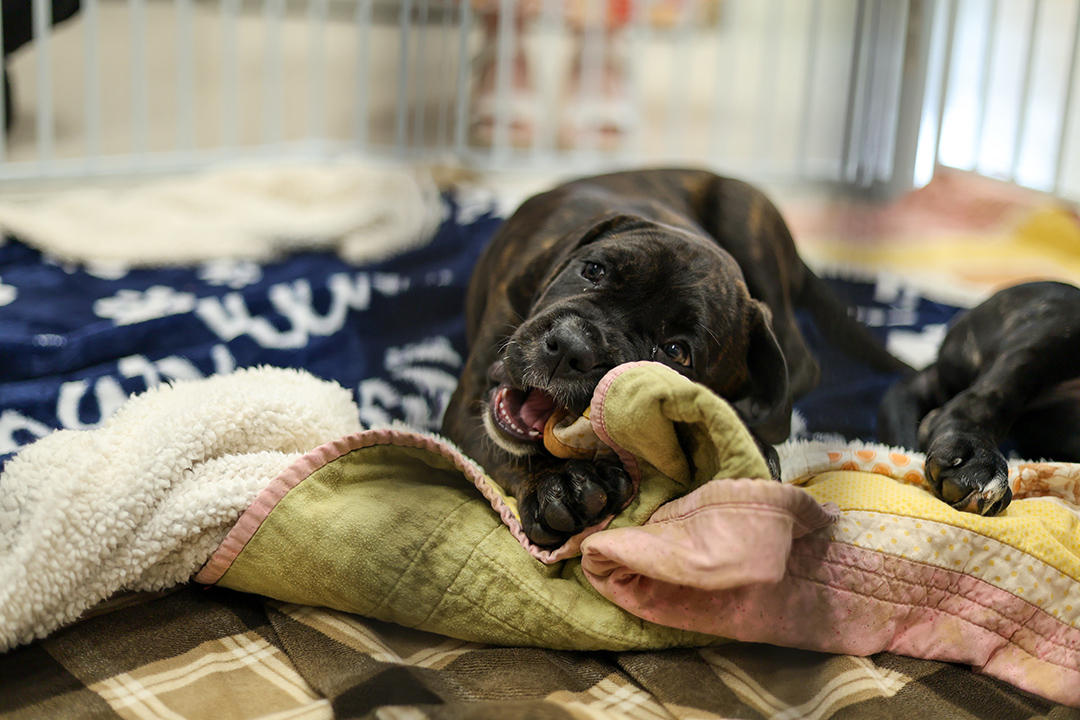
Back at home, Huber said Omen quickly proved herself to be a devoted mother. Sousa also recalls Omen’s strong maternal instincts during follow-up visits.
“She had to have her babies with her, she needed them around her,” said Sousa. “If we needed to move her … she just wanted to be with the babies.”
The weeks following the birth were not without challenges. Omen returned to the VMC after developing mastitis, an inflammation of the mammary glands, as well as complications at her surgical incision site. The hospital’s clinical team cleaned and treated the affected areas and monitored her recovery closely.
“Since [Omen] was breastfeeding, the puppies are often walking around [the impacted area], so I suggested keeping the area closed and clean as much as possible,” said Sousa.
As Omen recovered, she and her puppies had to be temporarily separated, which meant the puppies needed to be bottle-fed. Huber, carefully cared for both Omen and the puppies, documenting feeding schedules and tracking each puppy's progress.
But Huber wasn’t alone. She credits her brother, Evan, for helping care for Omen and her puppies through months of sleepless nights.
Omen’s condition improved, and she was eventually reunited with her puppies.
As the puppies grew older, they needed their series of vaccinations* — including the canine parvovirus vaccine — before being adopted into new homes. Protection against canine parvovirus is essential because the disease is a highly contagious and potentially fatal illness that attacks a dog’s gastrointestinal and immune systems.
Most of the costs associated with the puppies’ vaccination series were covered by the Les and Irene Dubé Good Samaritan Fund as well as through contributions from WCVM donor Christie Tetreault, whose canine parvovirus awareness campaign worked in partnership with the college’s fund. Tetreault’s dog Griffyn, who joined her forever home on Mother’s Day in 2023, nearly died from parvovirus at 14 weeks old.
Today, all nine puppies are beginning new lives with their adoptive families while Omen has found her forever home with Huber. Through the dedication of her loving owner, the expertise of the hospital’s clinical team and the generous support of WCVM supporters, Omen is living a happy, healthy life.
*Core vaccinations for dogs include the following: canine distemper virus, adenovirus (infectious hepatitis), canine parvovirus and rabies. Veterinarians also suggest non-core vaccines based on each dog’s lifestyle, geographic location and risk of exposure. Those vaccines are for canine Lyme disease, leptospira, kennel cough (alone or in combination with canine parainfluenza virus vaccine), and canine influenza virus. Talk to your veterinarian about the core vaccines that are recommended for all dogs. Your veterinarian can also alert you to specific disease risks in your area that you should be aware of.