
New clinical skills co-ordinators bolster vet education at WCVM
Two Western College of Veterinary Medicine (WCVM) graduates are back at school and helping veterinary students build their clinical skills, one year at a time.
By Lucas HorsmanIn the pursuit of continually improving the standard of veterinary education, the Western College of Veterinary Medicine (WCVM) provides its students with integrated courses that focus on developing their clinical skills training.
While clinical skills have been a part of the WCVM curriculum for many years, they were previously covered in the lab component of individual courses. When the college conducted a major revamp of its Doctor of Veterinary Medicine (DVM) degree program a few years ago, the review team shifted this content into a multi-year course that delivers about 70 hours per year of clinical skills instruction to veterinary students during the first three years of their program.
"We took the lab components for various courses and combined them all into one," said Dr. Bruce Wobeser (DVM, PhD), associate dean academic at the WCVM. "It’s pretty much a fundamental course in years one, two and three, and it's designed to give them the essential clinical skills that they need when they go in to practice."
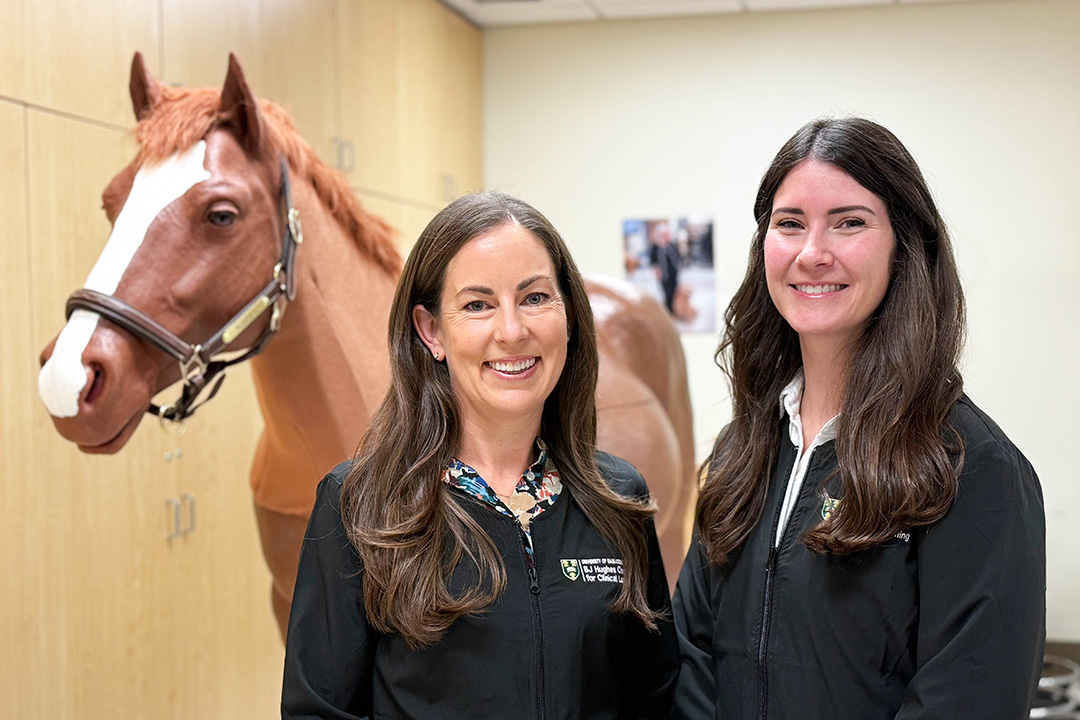
To enhance the delivery of these courses, the WCVM hired Drs. Katelyn McIntyre (DVM) and Allison Sproat (DVM) as the college’s new clinical skills co-ordinators. In addition to their experience as general practitioners, both veterinarians are WCVM alumni — and both are very optimistic about the educational value that these courses can provide.
"I think clinical skills [are foundational to] being a vet," said McIntyre, who graduated from the WCVM in 2014. "Starting with the basic skills and building on those [skills] year after year is the foundation of what they’ll be doing once they’ve graduated."
McIntyre and Sproat will work closely with managers Carolyn Cartwright and Sherry Presnell and their team of registered veterinary technologists (RVTs) and animal care attendants who operate the college’s teaching laboratories and spaces — including the BJ Hughes Centre for Clinical Learning (HCCL). This centre is home to a wide range of high-tech simulation models and technologies used by students to learn and practise practical skills in a safe environment.
Like other veterinary colleges in North America, the WCVM has steadily increased its use of simulated animal models and devices that allow students to practise their skills.
"The [BJ Hughes Centre’s] tech support team know the models inside and out, and know what we have available," said Sproat, a 2017 WCVM graduate. "They know everything about the room: the models, the capacity, [and] how they can be used. They’re instrumental in setting up the labs."
The models and simulations used in the clinical skills classes come in a wide range of shapes, sizes and materials — depending on what sort of procedure and animal species the students are learning about.
Many of the models found in the HCCL are named, often in honour of the donors who helped to purchase many of the centre’s resources. The entire facility is named after BJ (Bev) Hughes, who championed its creation and donated more than two-thirds of the funding needed to build the centre. Hughes passed away in May 2026.
"Much of the development of simulation gear has been made possible by donors," Wobeser said. "There are quite a number of donors who have donated very generously to provide many of the models here. The whole BJ Hughes Centre was really put in place because of the support of Bev Hughes and various donors."
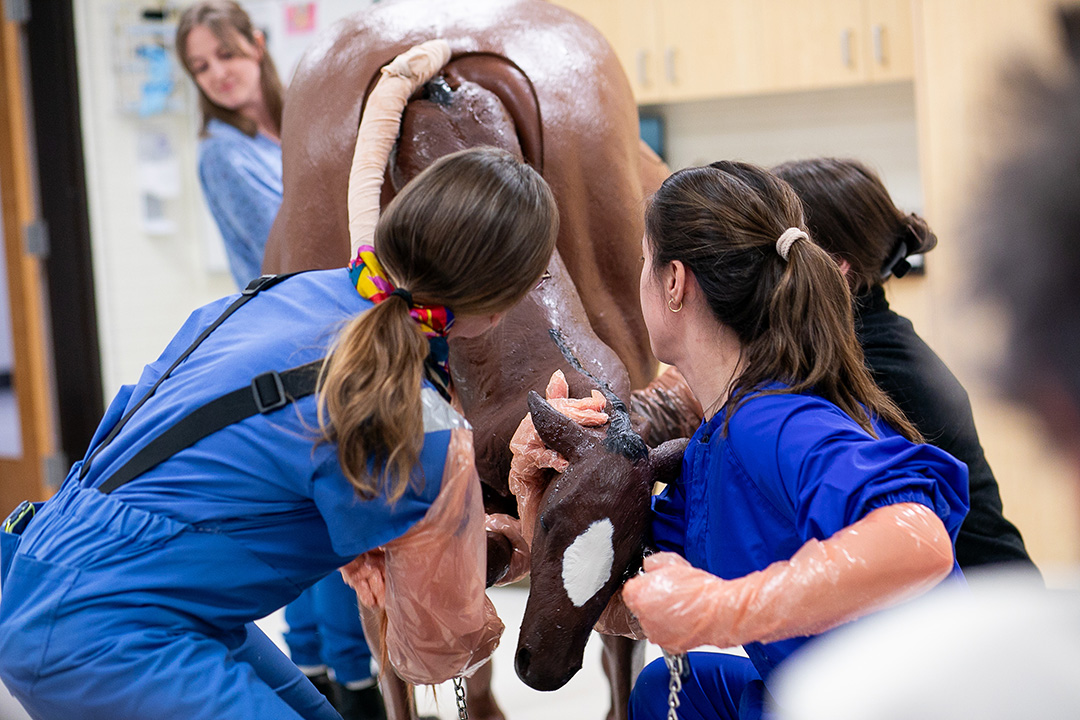
In addition to the purchased simulation models, Wobeser said that the WCVM’s academic team members have the skills and resources to create new simulation tools on site.
“We have the ability to create our own models here and sort of develop them from scratch,” he said. “What I foresee is that it will become a much more natural tool that we use ... because of this ability for students to do multiple replications or duplications [of skills].”
New educational tools — such as a life-sized equine dentistry model or interactive programs that simulate animal emergencies — demonstrate how far the veterinary field has come in developing hands-on teaching practices.
For many years, it was standard practice for veterinary students to develop their clinical skills on live animals. Gradually, there has been a shift away rom such practices — partly due to ethical concerns, and partly due to the additional stress that live animals can introduce to the learning process for early-year students.
"The way you get good at something is by doing it repeatedly," McIntyre said. "If you can place an IV (intravenous) catheter in a model’s synthetic vein over and over again until you get used to the movements and mechanics associated with that, then by the time you get a live animal in front of you, that’s the only variable that has changed."
Sproat said the first step for the new co-ordinator team will be to learn about the WCVM's programs and how they can help their new peers.
"We’re going to learn how the school year runs, how these labs have been delivered, and just gather as much information as we can and learn from the instructors ... and get more information about how we can help support [them]."
Lucas Horsman of Indian Head, Sask., is a journalism student at the University of Regina. Horsman was the WCVM’s summer research communications intern in 2026.