
Honey bees and human health: a social model for FASD
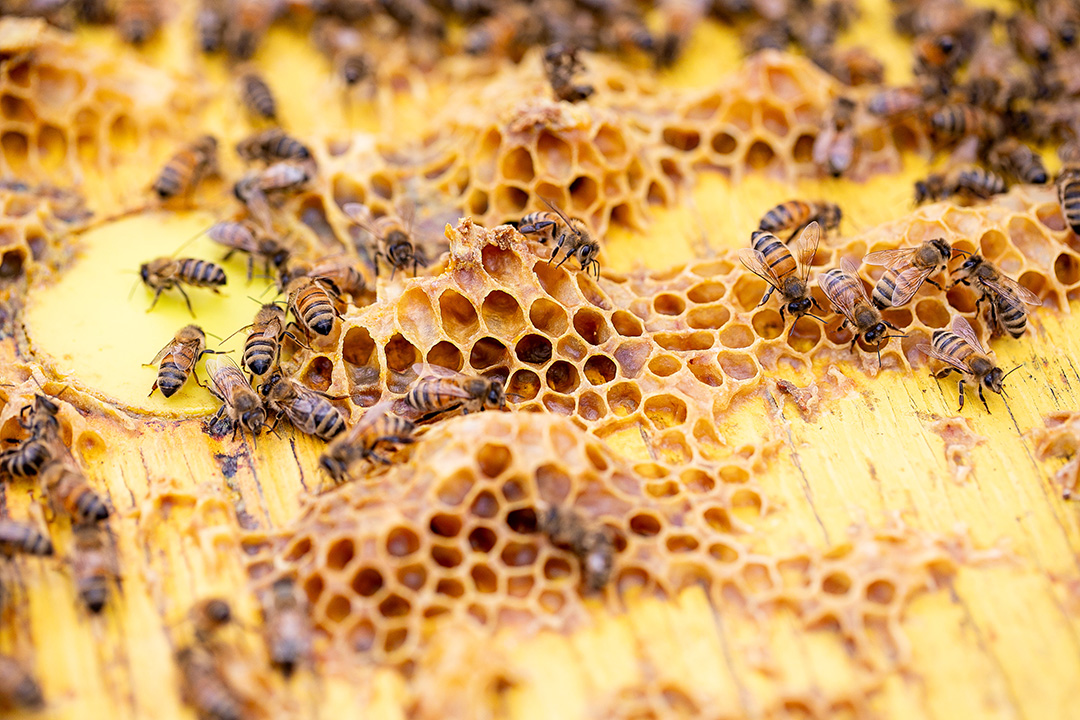
Taking tiny honey bee larvae from the field and raising them in a lab is part of my job as a master’s student at the University of Saskatchewan (USask).
By Maria JanserAs the larvae grow, I add small doses of alcohol into their diet — much like a human fetus that’s exposed to alcohol throughout a pregnancy.
Once the larvae develop as adult bees, I introduce them into a honey bee colony and then observe the behaviours of the alcohol-exposed bees.
These intensive tasks are helping our research team explore the potential of honey bees as a social animal model for fetal alcohol spectrum disorder (FASD), which can cause lifelong physical, behavioral and social struggles in affected individuals. FASD affects four per cent of Canadians, which is a higher percentage than autism, cerebral palsy and down syndrome combined.
But despite its common diagnosis, no researcher has found an animal model that can replicate all of FASD’s symptoms — including its complex social behaviours.
My graduate supervisor, Dr. Sarah Wood of the Western College of Veterinary Medicine (WCVM), believes honey bees hold promise as an animal model for FASD. These extremely social insects display complex and well-characterized behaviours including co-operative care of young, intentional communication, exchange of feed and division of labour.
And since honey bees are commonly managed in both agricultural and research settings, they’re affordable and practical to rear in a laboratory. Wood, a veterinary pathologist, holds the USask Research Chair in Pollinator Health. Last year, she received a $150,000 research grant from the Saskatchewan Health Research Foundation (SHRF) to explore honey bees’ potential as an animal model for FASD with an interdisciplinary group of collaborators.
One team member is Dr. Susan Bobbitt, a developmental pediatrician and an associate professor in the USask College of Medicine. In addition to her research and academic roles, she works with children affected by neurodevelopmental differences — including FASD.
Bobbitt points out the various gaps in current FASD research as well as its unique challenges and complexities.
“FASD research faces several interconnected challenges. The condition itself is highly heterogeneous with wide variation in physical, cognitive and behavioural features,” said Bobbitt, who is also a member of my graduate committee.
While Bobbitt hasn’t previously studied honey bees, their fit as an animal model for FASD quickly became apparent to her.
“As I became more involved, I learned about their sophisticated social behaviours and neurocognitive capacities, and it became clear how well they fit as a model for this type of research,” said Bobbitt.
Collaborating with a human physician who works with pediatric patients affected by FASD is extremely vital to the creation of a new animal model. Understanding how FASD affects people’s day-to-day lives helps to curate the model and its outcomes — including what behaviours to observe, the duration and dosages of alcohol, and future applications of this type of work.
“Most animal models focus on high, acute alcohol exposures rather than the more varied, intermittent or low-to-moderate exposures that occur in human pregnancies,” said Bobbitt.
She adds that there are difficulties quantifying timing, dosages and patterns in FASD research. Having more precise exposure science could help to clarify dose-response patterns.
In our preliminary honey bee model tested in summer 2025, we gave low, medium and high dosages of alcohol over multiple days of the honey bees’ development. This approach allows flexibility in the dosage and timing of the alcohol exposure as necessary over time.
While honey bees don’t exhibit the same distinct differences as humans, we still see variability in individual bees at various life stages. As bees age, they have specific corresponding tasks; our model allows us to observe if alcohol-induced changes affect any of these developmental stages differently.
Bobbitt explains that if honey bees prove to be a successful FASD model, it could create many areas of research — new questions, methods or intervention ideas.
“When clinicians, neuroscientists, educators, animal scientists and community partners work together, we can ask better questions and design our research to reflect the real-world complexities,” said Bobbitt, reiterating the importance of teamwork across research groups.
Ultimately, this project provides promise to advance both FASD research and future applications of honey bees, while demonstrating the importance and potential of interdisciplinary research.
Maria Janser of Prince Albert, Sask., is a USask Master of Science (MSc) student based at the Western College of Veterinary Medicine (WCVM) who is working on her “dream project.” In August 2026, Janser became a first-year student in the USask College of Medicine.